
Just Laid Off in 2026? Don't Sign That Severance Yet. Here Are 8 Clauses That Could Cost You Tens of Thousands
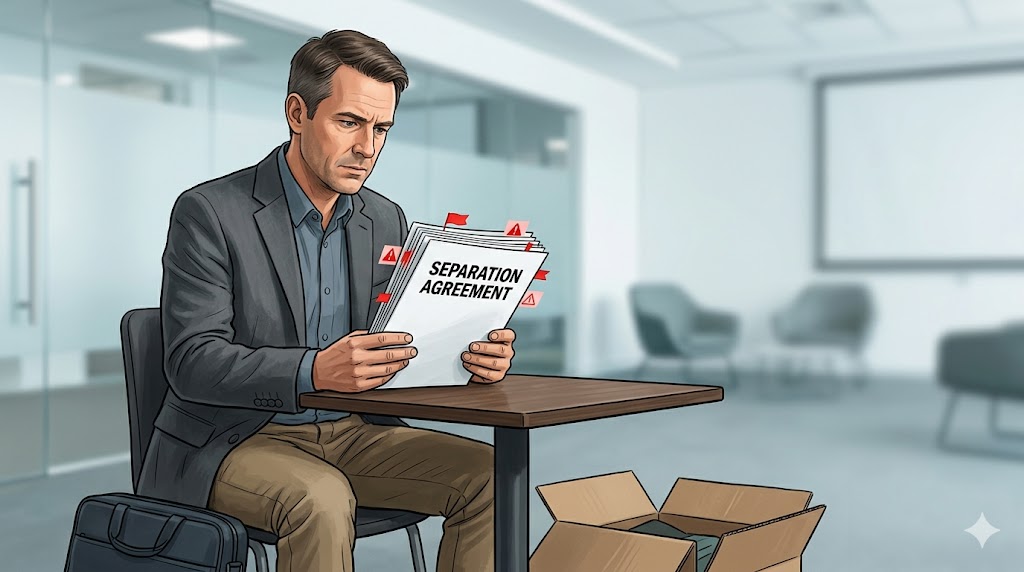
The conference invite landed on your calendar this morning with a name you have never heard of. You walked in. There was an HR person, your manager, and a slide deck. The deck said "role elimination" or "restructuring" or "alignment with strategic priorities." Twenty minutes later, you walked out with a laptop bag, a cardboard box, and a PDF titled "Separation Agreement and General Release."
The PDF is 14 pages long. The HR person told you that you have until next Friday to sign and return it. They mentioned the severance amount (two weeks per year of service, or one month, or three months) and said it is the "standard package." They said most people sign the same day.
Do not sign it the same day.
So far in 2026, U.S. employers have filed 766 WARN Act notices affecting more than 91,000 workers across 37 states. Challenger, Gray & Christmas counted 108,000 announced job cuts in January 2026 alone, a 118% increase year over year. Meta confirmed on April 23 that it will cut 8,000 jobs (10% of its workforce) effective May 20, with a severance package of 16 weeks of base pay plus 2 weeks for every year of service. The same day, Microsoft offered voluntary "buyouts" to roughly 8,750 U.S. employees (7% of its U.S. workforce), its first-ever such program in 51 years. Block is in the middle of a reduction. The severance agreement on your desk was almost certainly drafted by a law firm that has been writing them at industrial scale for the last three months.

Source: CNBC, 20,000 job cuts at Meta, Microsoft signal AI-driven labor crisis (Apr 24, 2026)
That agreement is not designed to be fair to you. It is designed to extinguish every legal claim you might have against the company in exchange for the smallest sum the company believes you will accept. And it is full of clauses that, if you sign without negotiation, will quietly cost you tens of thousands of dollars in stock, future employment, legal claims, and your final paycheck.
Here are eight of them.
1. The General Release of Claims: What You Are Actually Giving Up
Why they say it: The release is the entire reason the severance exists. The money is consideration, payment for your signature on this paragraph. Without it, the company gets nothing for the check it is cutting you. With it, every potential lawsuit you could have brought, for discrimination, for unpaid wages, for retaliation, for harassment, is dead the moment you sign.
What you are actually waiving:
- Discrimination claims under Title VII (race, color, religion, sex, national origin), the ADA (disability), the ADEA (age 40+), the Equal Pay Act, and the equivalent state statutes (FEHA in California, NYSHRL in New York, etc.).
- Wage and hour claims: unpaid overtime, misclassification as exempt, off-the-clock work, missed meal/rest breaks, expense reimbursements.
- Retaliation claims for whistleblowing, taking FMLA leave, filing a workers' comp claim, or reporting harassment.
- Common-law claims like wrongful termination, defamation, breach of contract, intentional infliction of emotional distress.
What you cannot waive even if the agreement says so:
- The right to file a charge with the EEOC, NLRB, OSHA, SEC, or DOL. Federal agencies have repeatedly held that severance agreements cannot bar an employee from filing an administrative charge or cooperating with an investigation. The most a release can do is bar you from personally collecting monetary damages from the lawsuit, but the agency can still investigate and act. Any clause that says "Employee agrees not to file a charge with any agency" is unenforceable on its face.
- Future claims that arise after you sign. The release covers claims that already exist on the day you sign; it cannot waive things the company does to you next month.
- Workers' compensation claims in most states.
- Vested retirement benefits under ERISA. You cannot sign these away.
2. The OWBPA Trap for Workers 40 and Older
Why they say it: Because the Older Workers Benefit Protection Act (OWBPA), the federal law governing severance for employees 40 and older, gives you specific, non-waivable review periods. Employers know that if they highlight these rights, you are more likely to use them. So they bury them or skip them entirely.
What the law actually says. If you are 40 or older and the severance asks you to release age discrimination claims under the ADEA, the OWBPA requires:
- 21 days to consider the agreement for an individual termination, or 45 days if you are part of a group layoff (more than one employee being terminated).
- 7 days after signing to revoke your acceptance, and the agreement does not become effective until that 7-day period expires. This right cannot be waived. Ever.
- Plain English. The agreement must be written so that the average person being asked to sign it can understand it.
- Specific reference to the ADEA. A general release that does not specifically name the ADEA does not effectively waive ADEA claims.
- Written advice to consult an attorney. Required in the agreement itself.
- For group layoffs specifically: the company must give you a written list of the job titles and ages of every employee selected for termination and every employee in the same job class who was not selected. This disclosure is what lets you tell whether the layoff was age-discriminatory.
If any of these requirements are missing, the ADEA waiver is invalid, meaning you can take the severance and still sue for age discrimination. The Supreme Court confirmed this in Oubre v. Entergy Operations (1998): an OWBPA-defective release is unenforceable as to ADEA claims, and the employee does not have to return the severance to sue.
Your right: Take the full 21 or 45 days. Use them to consult a lawyer. Most employment lawyers offer free consultations on severance agreements because they hope to find a real claim. Use the 7-day revocation right if you change your mind after signing. None of these can be shortened, waived, or "rolled into" the offer letter. If the company is rushing you, that itself is a sign something is wrong with the agreement.
3. Non-Compete Clauses: Now a State-by-State Lottery
Why they say it: Because they would rather you not work for a competitor, and the cheapest way to achieve that is to put it in writing and hope you do not test it. Many companies bundle a new non-compete into the severance agreement, even if you never signed one when you were hired.
What changed in 2026: The FTC's nationwide ban on non-compete agreements was struck down by the U.S. District Court for the Northern District of Texas in August 2024 (Ryan LLC v. FTC). The FTC formally withdrew its appeals in September 2025 and removed the rule from the Code of Federal Regulations in February 2026. There is no federal ban on non-competes today. Enforcement is now entirely a state-law question, and the states have moved aggressively in opposite directions:
- California (Bus. & Prof. Code § 16600): Non-competes are void. Period. As of 2024, California also requires employers to notify current and former employees that any non-compete they signed is unenforceable, and creates a private right of action with attorney's fees for violations.
- Minnesota (effective July 2023): Non-competes are void for all employees regardless of salary.
- North Dakota and Oklahoma: Non-competes are void by statute.
- Colorado, Washington, Illinois, Massachusetts, Oregon, Maine, Maryland, New Hampshire, Rhode Island, Virginia: Non-competes void below specified income thresholds (typically $75K–$150K) or otherwise heavily restricted.
- New York: A near-total ban passed the legislature in 2023 but was vetoed; restrictions are still being negotiated, and case law remains hostile to broad non-competes.
- Texas, Florida, Georgia, most other states: Non-competes are still enforceable if "reasonable" in scope, geography, and duration, but courts will scrutinize them.
The severance-agreement-specific danger: Even in states where non-competes are restricted, a non-compete you agree to in exchange for severance pay can be treated as supported by independent consideration, making it more enforceable than the one you signed when you started the job. In other words, the very act of accepting your severance can be the thing that creates a binding non-compete. This is why some severance agreements introduce a non-compete that was never in your original offer.
Your right: Read every restrictive covenant (non-compete, non-solicit, non-recruit, "garden leave") line by line. If your home state restricts or bans non-competes, push back hard on inclusion. If you must accept one, negotiate scope (specific competitors only), geography (city or state, not nationwide), and duration (3 to 6 months max). And get a carve-out for your specific job function or industry vertical.
4. Non-Disparagement and Confidentiality: The McLaren Macomb Issue
Why they say it: To prevent you from telling future employers, journalists, regulators, your union, or your former coworkers what really happened. To prevent you from posting about it on Glassdoor, LinkedIn, or X. To prevent your severance number from leaking and becoming the floor for everyone else who is laid off after you.
What the law actually says. In February 2023, the National Labor Relations Board ruled in McLaren Macomb, 372 NLRB No. 58, that overly broad non-disparagement and confidentiality clauses in severance agreements violate Section 7 of the National Labor Relations Act. Section 7 protects employees' rights to engage in "concerted activity", including discussing wages, working conditions, and terms of employment with each other.
The NLRB held that severance clauses that:
- prevent the employee from discussing the existence or terms of the agreement with coworkers,
- prevent the employee from speaking publicly about the company or working conditions,
- or chill the employee's ability to file charges, assist coworkers, or talk to a union,
are themselves unlawful, and the mere offering of such a clause violates the Act, regardless of whether the employee signs.
This applies to most private-sector employees in the United States (the NLRA covers nearly everyone except agricultural workers, supervisors, and federal/state employees). It does not require you to be unionized.
Important 2025 update: On February 14, 2025, the NLRB's Acting General Counsel rescinded the Biden-era enforcement memo (GC 23-05) that had directed regional offices to apply McLaren Macomb aggressively. The underlying decision is still binding NLRB precedent; the Sixth Circuit affirmed it in September 2024. But the rescission means regional offices have more discretion in how they apply it. Practically: an overbroad gag clause is still unlawful, but the political appetite to challenge one has cooled. Employees who want to enforce their rights under McLaren Macomb may need to push harder than they would have in 2023 to 2024.
The Speak Out Act layer. On top of McLaren Macomb, the federal Speak Out Act of 2022 makes pre-dispute non-disclosure and non-disparagement clauses unenforceable in cases involving sexual assault or sexual harassment disputes. If your departure has anything to do with harassment, no NDA the company writes can silence you about it.
Your right: A narrowly tailored non-disparagement clause (for example, "you will not make false or defamatory statements") may still be enforceable. But a broad gag order that prevents you from discussing your wages, working conditions, or the layoff itself is presumptively invalid. You can negotiate carve-outs: the right to discuss compensation with future employers, the right to speak truthfully to government agencies, the right to make true statements about your experience.
5. Forced Arbitration and Class Action Waivers
Why they say it: Arbitration is private, faster for the employer, and statistically much friendlier to repeat-player defendants (which large employers are). Class action waivers prevent you from joining other employees with the same complaint. A discrimination claim worth $20,000 individually but $20 million collectively can never be brought collectively against the company.
What the law actually says. The Federal Arbitration Act broadly enforces arbitration clauses, and the Supreme Court upheld class-action waivers in employment arbitration agreements in Epic Systems v. Lewis (2018). So in most cases, these clauses are enforceable.
But there are major recent carve-outs:
- Ending Forced Arbitration of Sexual Assault and Sexual Harassment Act (2022): Federal law. Employees can void any pre-dispute arbitration clause for any sexual assault or sexual harassment claim, at the employee's option, even after signing. The employer cannot force arbitration of these claims.
- Speak Out Act (2022): Pre-dispute NDAs and non-disparagement clauses related to sexual harassment and assault are unenforceable.
- California (AB 51, partially in effect): Imposes restrictions on mandatory arbitration in employment, though heavily litigated and narrowed by federal preemption.
- Several states have anti-arbitration laws for specific claims, though many are preempted by the FAA.
The severance-specific issue: The arbitration clause you signed when you were hired might already cover post-employment disputes. But severance agreements often re-introduce or expand arbitration provisions, covering disputes about the severance agreement itself, future cooperation obligations, and any claim that the release does not cover. Negotiate this. At minimum, push for: the right to choose the arbitrator, the company paying all arbitration fees and costs, and the right to seek injunctive relief in court.
6. Equity, RSU, and Stock Option Forfeiture
Why they say it: Because for tech workers especially, equity is often the largest part of total compensation, frequently larger than the severance itself. A clause that lets the company claw back, accelerate, or limit your equity rights is worth more to them than the entire cash severance package.
What you should check, before you sign:
- Vesting acceleration. Some companies, particularly post-IPO tech firms, have policies that accelerate vesting in connection with a layoff (sometimes called "involuntary termination without cause"). Read your equity plan and award agreement. If acceleration applies, the severance agreement should not be allowed to take it away.
- Post-termination exercise window. The default for incentive stock options (ISOs) is 90 days to exercise after termination, after which they convert to non-qualified options or expire. Many companies extend this to 1–10 years for laid-off employees, but only if you ask. The cost of exercising vested options (strike price + tax) can run into tens or hundreds of thousands of dollars; being forced to exercise within 90 days while unemployed is often impossible.
- Cliff vesting and pro-rata credit. If you are days away from a vesting cliff or your next quarterly vest, ask for it to be honored. Many employers will say yes, especially for involuntary terminations.
- Conflict-of-terms language. Watch for clauses that say the severance agreement overrides your equity plan. The equity plan is generally the more favorable document; do not let the severance override it silently.
Your right: Equity is a separate contract from your employment. Severance terms that purport to forfeit, accelerate, or modify equity must be read in light of the original equity plan documents, and you should ask for those documents in writing if you do not have them. The single most valuable severance negotiation in many cases is not more cash, it is a longer post-termination exercise window for vested options.

Source: The Next Web, Meta's May 2026 severance: 16 weeks base + 2 weeks per year of service
7. Cooperation Clauses: The Open-Ended Future Obligation
Why they say it: Because the company knows that some lawsuit, audit, or investigation is going to come up in the next several years that requires your testimony, and they would rather have a contractual right to your unlimited time than have to pay you for it later.
The problem: "Cooperation" is undefined. Without limits, this clause can require you to:
- Spend hours preparing for depositions in cases years after you left
- Travel to meetings and trials at your own expense
- Respond to email and phone calls from company lawyers with no time limit
- Sit for interviews with regulators on the company's behalf
- Sign affidavits the company drafts for you
All "without additional compensation."
What to negotiate:
- Reasonable hourly compensation for your cooperation time (your prior compensation rate, or a market consulting rate).
- All expenses reimbursed: travel, lodging, meals.
- Counsel of your choice paid for by the company if your testimony exposes you personally.
- Time limits: cooperation only required for X months after separation.
- Truthfulness override: explicit statement that nothing in the cooperation clause requires you to make any statement that is not truthful.
Your right: A cooperation clause is not standard boilerplate to be initialed. It is an open-ended obligation that can stretch years into your future. Treat it like a contract for future services and negotiate the terms accordingly.
8. Final Pay, PTO, and the Severance That Hides Your State-Law Wages
Why they say it: If the company can fold your earned wages, your accrued PTO, and your earned bonus into the severance number and call it all "severance," they have just paid you the money you were already owed and asked you to release every claim in exchange for nothing.
What state law actually requires (this is the biggest variation):
- California (Labor Code §§ 201 to 203): All earned wages, including accrued vacation, must be paid immediately upon involuntary termination (or within 72 hours of voluntary resignation). Failure to pay triggers "waiting time penalties" of one full day's wages for every day late, up to 30 days. PTO is treated as wages and cannot be forfeited. A severance agreement cannot lawfully fold these obligations into the severance. The wages are owed regardless.
- Massachusetts (G.L. c. 149, § 148): Final wages including unused vacation due on the day of involuntary termination. Treble damages and attorney's fees for violations.
- New York (Labor Law § 191): Final wages due no later than the next regular payday. Earned commissions and bonuses are wages.
- Colorado, Hawaii, Illinois, Minnesota, Montana, Nevada, Oregon, Washington: Statutory final-pay deadlines, most requiring payment on the day of termination or within 24–72 hours.
- Texas, Florida, Georgia, and most states without a state final-pay statute: Default to the next regular payday, but state wage statutes still typically require payment of all earned wages.
Earned bonuses and commissions are usually owed regardless of whether you are still employed on the payment date. The test is whether you earned them under the plan terms before separation. Severance agreements often try to cancel them. State courts in California, Massachusetts, and others have repeatedly struck down such forfeitures.
Your right: Your earned wages, PTO, and bonuses are owed separately from any severance. They are not negotiation chips. They are not "consideration" for your release. The severance is the additional payment in exchange for your signature. If your agreement bundles them all together, or worse, conditions payment of earned wages on signing the release, that is itself often a violation of state wage law.
1. Earned wages through your last day worked (you are owed this regardless).
2. Accrued PTO at your final pay rate (in most states, you are owed this regardless).
3. The actual net new severance offered above and beyond #1 and #2.
Number 3 is what you are actually being offered. If a "12 weeks of severance" package only contains 6 weeks of new money once you back out earned wages and PTO, it is a 6-week offer, not a 12-week offer.
What Is Actually Negotiable
The single most damaging belief about severance agreements is that they are non-negotiable. They almost always are. Here is what is on the table in nearly every layoff:
- The severance amount itself. "Two weeks per year of service" is a starting offer. Long-tenured employees, employees with strong performance reviews, employees who can credibly point to a potential legal claim, and employees in protected demographics often successfully negotiate up. A 25–50% increase is common.
- Continued health insurance (COBRA) at the company's expense. Often offered for 3–6 months, frequently extendable.
- Accelerated vesting or extended option exercise windows. Discussed in Section 6.
- Removal or narrowing of non-compete and non-solicit clauses.
- Outplacement services paid by the company.
- Mutual non-disparagement instead of one-sided.
- A neutral or positive reference letter in writing.
- Carve-outs from the release for vested benefits, indemnification rights, future claims, and government cooperation.
- Extended deadline to review the agreement beyond what the company first offers.
What To Do This Week
If you got your severance agreement today and your deadline is "Friday":
- Do not sign today. The company expects negotiation; the deadline is rarely as firm as it sounds. Even a 24-hour delay to read carefully changes nothing for them and changes everything for you.
- If you are 40 or older, confirm in writing that you are getting your full OWBPA review period (21 days individual, 45 days group). Email HR. Get the response in writing.
- Read every clause, even the ones in the back. The most expensive trap is usually buried; equity, cooperation, and final-pay clauses are typically near the end.
- Calculate your real number: earned wages + PTO + new severance separately, as above.
- Talk to an employment lawyer. Many offer free 30-minute consultations on severance review. The cost-benefit is enormous: a lawyer who finds one negotiation point worth a few thousand dollars has paid for themselves many times over.
- Negotiate in writing, professionally. "I appreciate the offer. After review, I would like to discuss the following points before signing: [list]." Companies expect this. HR has authority to come back with a counter.
You Already Signed. Now What?
If you signed three days ago and just realized you waived something you should not have:
- If you are 40+, you have 7 days from signing to revoke the ADEA waiver. This right cannot be waived. Send a written revocation to HR and the lawyer who drafted the agreement, by email and certified mail. After revocation, the ADEA portion of the release is void.
- If you find that the OWBPA requirements were not met (no 21/45-day review, no 7-day revocation right, no plain English, no specific reference to ADEA, no list of selected/non-selected employees in a group layoff), the ADEA waiver may be voidable even after the revocation period. Oubre v. Entergy Operations lets you sue for age discrimination without returning the severance.
- For sexual harassment or assault claims, the Speak Out Act and the Ending Forced Arbitration Act let you void NDA and arbitration provisions even after signing. The release of those specific claims may also be challengeable.
- For NLRB-protected activity (discussing wages, working conditions, supporting coworkers), McLaren Macomb gives you grounds to challenge overbroad confidentiality and non-disparagement clauses with the NLRB.
The agreement is not as final as the company makes it sound. Get a lawyer.
On My Terms reads your severance agreement in plain English in seconds, flagging the release scope, OWBPA compliance, non-compete enforceability in your state, equity forfeiture, and final-pay traps. Upload your agreement at onmyterms.fyi/employment-contract-review before your signing deadline. It is free, encrypted, and never shared with your employer.
This article is for general information only and is not legal advice. Employment law varies significantly by state, and the right course of action in your situation depends on facts a lawyer would need to assess. If you have been laid off and offered a severance, consult an employment attorney before signing. Most offer free initial consultations on severance review.
Don't sign what you don't understand
Upload your document and get a plain English breakdown in minutes.
Analyze Your Document