
The Indian Contract Act, 1872 — Decoded: Every Clause That Governs Your Daily Life
Every time you tap "I Agree" on an app, sign a rental lease, shake hands on a business deal, or even buy vegetables from a street vendor — you are entering a contract governed by a law written in 1872. That is not a typo. The Indian Contract Act, enacted on April 25, 1872, is the backbone of every commercial relationship in India, and it has not been replaced in over 150 years.
Most people have never read it. Most people have never even heard of it beyond a college exam. And that is exactly how bad contracts catch people off guard.
This post is going to change that. We are going to walk through the entire Act — not in legalese, but in language that actually makes sense. By the end, you will understand what makes a contract valid, what makes it void, what happens when someone breaks one, and where the real traps lie in the documents you sign every day.
Let's get into it.
Why a 150-Year-Old Law Still Matters
The Indian Contract Act was originally passed as Act No. 9 of 1872 during British colonial rule. It was designed to bring order to commercial relationships across the subcontinent. Since then, India has gone through independence, economic liberalization, the digital revolution, and the rise of a startup economy worth hundreds of billions of dollars.
Through all of that, this Act has remained the governing framework.
Why? Because the principles it lays down are fundamental. Offer. Acceptance. Consideration. Free consent. These concepts don't go out of date. Whether you're negotiating a billion-dollar merger or subscribing to a streaming service, the same foundational rules apply.
Several specialized laws have been carved out of it over the years — the Sale of Goods Act (1930), the Indian Partnership Act (1932), the Negotiable Instruments Act — but the core framework of what constitutes a valid contract, what vitiates consent, and what happens on breach still lives here.
Understanding this Act is not optional. It is a survival skill.
The Building Blocks: What Actually Makes a Contract? (Sections 1–9)
Agreement vs. Contract — The Distinction That Trips Everyone Up
Here is the single most important distinction in Indian contract law: every contract is an agreement, but not every agreement is a contract.
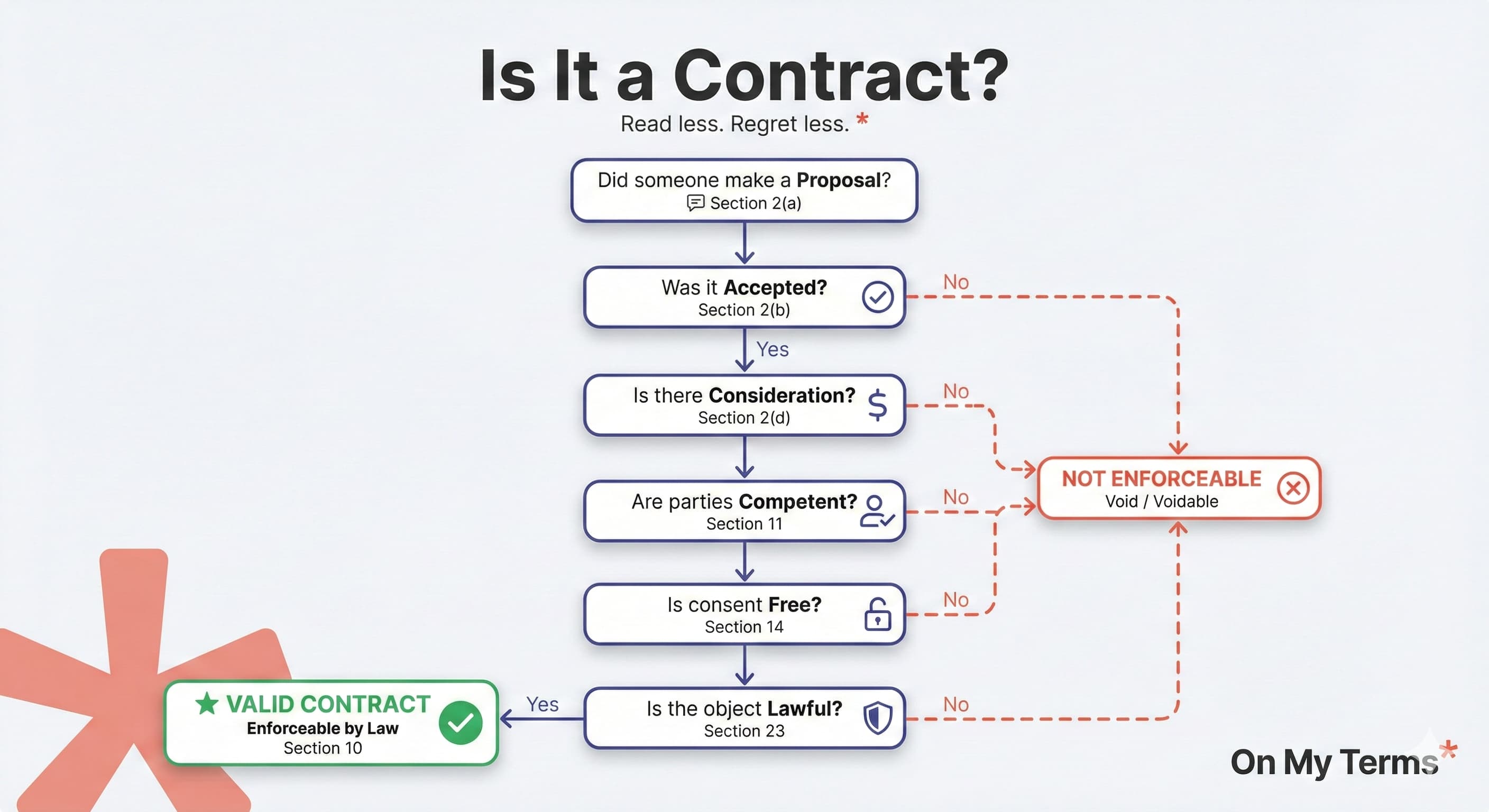
An agreement becomes a contract only when it is enforceable by law. And for that to happen under Section 10, it needs four things:
- Free consent of the parties
- Competency to contract
- Lawful consideration and lawful object
- Not expressly declared void by any law
Miss any one of these, and your "contract" is just a piece of paper — or worse, a trap you can't enforce.
Proposal, Acceptance, and Promise
The Act uses the word "proposal" where modern language uses "offer." When you signify your willingness to do or abstain from doing something, with a view to getting the other person's agreement — that is a proposal (Section 2(a)).
When the other person agrees to it, the proposal becomes a promise. And when both sides have made promises to each other — that set of mutual promises is an agreement.
Communication: When Does a Contract Actually Come Into Existence?
This is where it gets interesting — and where a lot of disputes originate. Section 4 lays down precise rules about when communication is complete:
- A proposal is complete when it reaches the person it was made to.
- An acceptance is complete against the proposer when it is sent (put in transmission), and against the acceptor when it reaches the proposer.
- A revocation follows the same logic.
Think about that for a moment. If you mail an acceptance letter, you are bound the moment you post it — but the proposer is only bound when they receive it. This asymmetry has been the basis of countless disputes, and it applies to emails and digital communications too.
Revocation: You Can Take It Back — But Only Before It's Too Late (Sections 5–6)
A proposal can be revoked any time before acceptance is complete against the proposer. An acceptance can be revoked before the communication of acceptance is complete against the acceptor.
A proposal can also lapse in four ways: the proposer communicates revocation, the time period expires, a condition precedent fails, or the proposer dies or becomes insane before acceptance.
Acceptance Must Be Absolute (Section 7)
This is a red flag that catches people constantly: a conditional acceptance is not an acceptance at all. It is a counter-proposal.
If someone offers to sell you a car for five lakhs and you respond saying "I'll take it for four," you have not accepted their offer — you have rejected it and made a new one. The original offer is now dead unless explicitly revived.
Contracts, Voidable Contracts, and Void Agreements (Sections 10–30)
This is arguably the most critical chapter of the entire Act because it draws the line between enforceable contracts, contracts that can be undone, and agreements that were never enforceable to begin with.
Who Can Enter a Contract? (Section 11)
Three requirements:
- Age of majority — You must be 18 (or 21 if a guardian has been appointed by a court). The landmark case of Mohori Bibee v. Dharmodas Ghose established definitively that a minor's agreement is void — not merely voidable, but entirely void from the start.
- Sound mind — You must be capable of understanding the contract and forming a rational judgment. A person of unsound mind who has lucid intervals can contract during those intervals. Conversely, a person of sound mind who is temporarily impaired (intoxicated, delirious) cannot contract during that period.
- Not disqualified by law — Certain categories like foreign sovereigns, insolvents, and convicts have restrictions.
Free Consent: The Five Poisons (Sections 13–22)
Consent means both parties agree on the same thing in the same sense (Section 13). Free consent means that agreement was not caused by any of these five factors:
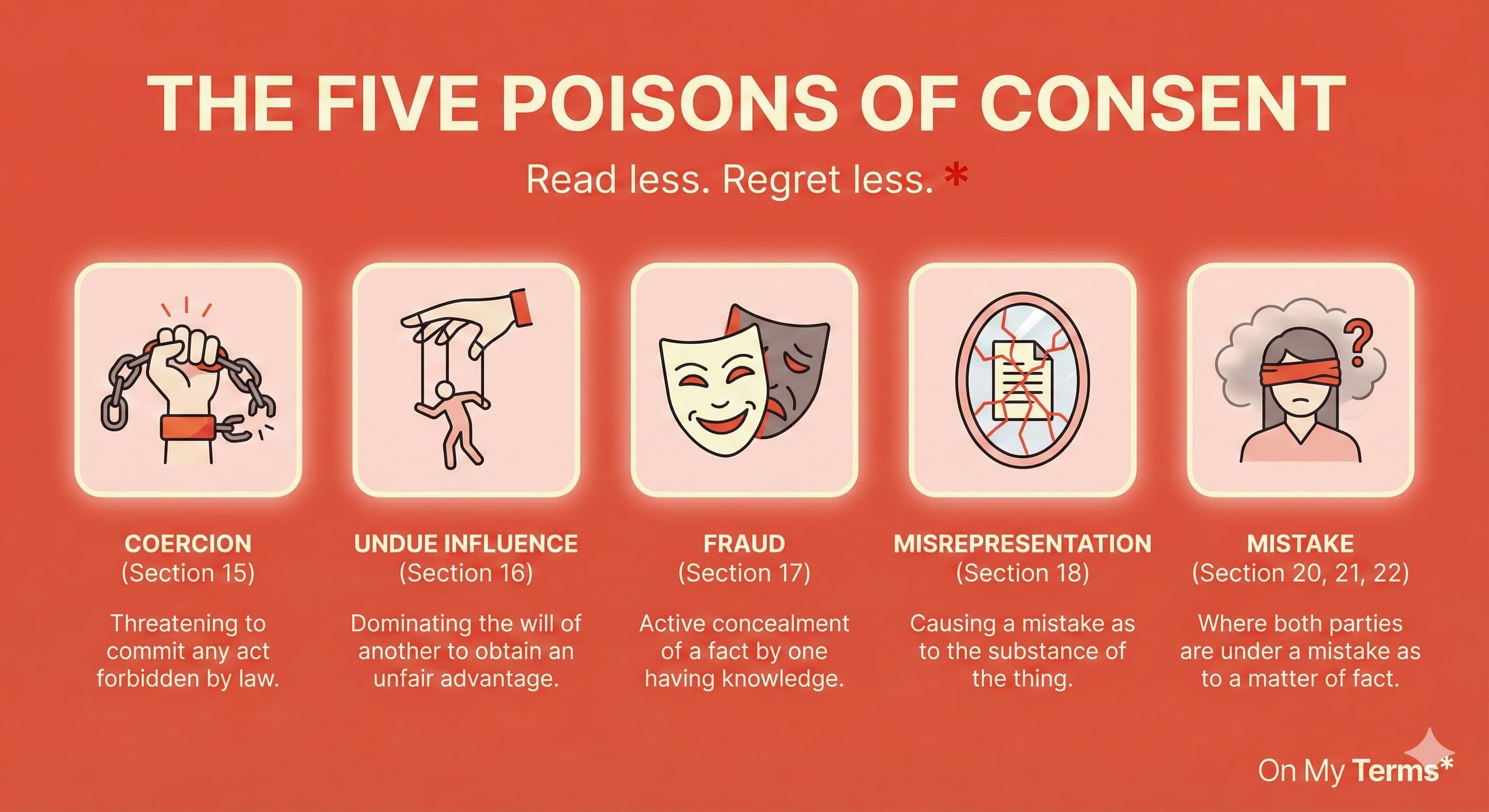
1. Coercion (Section 15): Committing or threatening to commit any act forbidden by the Indian Penal Code, or unlawfully detaining property, to force someone into an agreement. The Act is clear — it does not matter whether the IPC is actually in force at the place where the coercion happens.
2. Undue Influence (Section 16): When one party is in a position to dominate the will of the other — through a real or apparent authority, a fiduciary relationship, or the other party's mental or physical vulnerability — and uses that position for unfair advantage. Crucially, when the dominant party enters an unconscionable transaction, the burden of proving there was no undue influence shifts to them.
This comes up constantly in landlord-tenant disputes, employer-employee relations, and family financial arrangements. A moneylender pressuring a desperate farmer. A parent leveraging influence over an adult child's finances. An employer inserting unreasonable non-competes.
3. Fraud (Section 17): Active deception with intent. This includes false statements of fact, active concealment, promises made without intention to perform, and any act fitted to deceive. But here is the nuance: mere silence is generally not fraud — unless the circumstances impose a duty to speak, or unless the silence itself is equivalent to speech.
4. Misrepresentation (Section 18): Similar to fraud but without the intent to deceive. An honest but unwarranted assertion, a breach of duty that misleads without intent, or causing a mistake about the substance of the agreement. The key difference from fraud: if the party whose consent was caused by misrepresentation could have discovered the truth with ordinary diligence, the contract may not be voidable.
5. Mistake (Sections 20–22): Only a bilateral mistake about a matter of fact essential to the agreement makes it void (Section 20). A unilateral mistake of fact does not. And a mistake of law in force in India has no effect at all — you are presumed to know the law.
What Cannot Be a Contract: Void Agreements (Sections 24–30)
The Act explicitly declares these agreements void:
- Partly unlawful consideration or object (Section 24): If any part of the consideration for a single promise is unlawful, the whole agreement fails.
- No consideration (Section 25): No consideration, no contract — with three exceptions: written and registered agreements based on natural love and affection between near relations, promises to compensate for voluntary past acts, and written promises to pay time-barred debts.
- Restraint of marriage (Section 26): Any agreement restricting the marriage of any person (other than a minor) is void. Full stop.
- Restraint of trade (Section 27): Any agreement by which a person is restrained from exercising a lawful profession, trade, or business is void — with the notable exception of goodwill clauses in business sales.
- Restraint of legal proceedings (Section 28): Agreements that restrict a party from enforcing rights through normal legal channels are void, though arbitration clauses are specifically preserved.
- Uncertain agreements (Section 29): If the meaning of an agreement is not certain or capable of being made certain, it is void.
- Wagering agreements (Section 30): Bets are void and unenforceable — with an exception carved out for horse-racing prizes above 500 rupees.
Why this matters to you: Every time you sign a non-compete clause, an arbitration agreement, or a document with vague deliverables, these sections determine whether those clauses will actually hold up in court.
Contingent Contracts: When the Deal Depends on "If" (Sections 31–36)
A contingent contract is a contract to do or not do something, conditioned on some event that may or may not happen. Insurance policies are the most common example — your fire insurance contract only triggers if your property actually catches fire.
The rules are elegant:
- Contingent on an event happening (Section 32): Cannot be enforced until the event happens. If the event becomes impossible, the contract is void.
- Contingent on an event not happening (Section 33): Can only be enforced when the event becomes impossible.
- Future conduct of a living person (Section 34): The event is deemed impossible when the person does something that renders it impossible for the event to happen.
- Within a fixed time (Section 35): If the event does not happen or becomes impossible before the time expires, the contract is void.
- Contingent on impossible events (Section 36): Void from the start, whether or not the parties knew the event was impossible.
Performance of Contracts: Who Does What, When, and Where (Sections 37–67)
The Core Obligation (Section 37)
Parties to a contract must either perform or offer to perform their respective promises. Promises are binding even on the representatives of the promisors after death, unless a contrary intention appears from the contract.
This is significant. If you contract with someone to deliver goods and they die, their legal heirs are bound by that promise. Personal obligations (like painting a specific portrait) are the exception.
Reciprocal Promises: The Domino Effect (Sections 51–58)
Most contracts involve reciprocal promises — "I'll do X if you do Y." The Act has precise rules for these:
- If they are to be performed simultaneously, neither party needs to perform until the other is ready and willing (Section 51).
- If there is a specific order, that order must be followed (Section 52).
- If one party prevents the other from performing, the contract becomes voidable at the option of the party prevented, who is also entitled to compensation (Section 53).
- Time as the essence: When time is expressly made essential and a party fails to perform on time, the contract becomes voidable at the other party's option (Section 55). When time is not essential, failure to meet a deadline does not void the contract but does entitle the promisee to compensation.
When Contracts Don't Need to Be Performed (Sections 62–67)
Contracts can be discharged through:
- Novation (Section 62): Parties agree to substitute a new contract for the old one. The old contract dies.
- Rescission (Section 62): Parties agree to cancel the contract.
- Alteration (Section 62): Parties agree to change the terms. The original contract is replaced.
- Remission (Section 63): The promisee can accept less than what was promised, extend the time, or accept any satisfaction they choose.
- Impossibility (Section 56): An agreement to do an impossible act is void. More importantly, a contract that becomes impossible or unlawful after formation becomes void at that point — this is the doctrine of frustration in Indian law.
Quasi-Contracts: When There's No Contract but There's Still an Obligation (Sections 68–72)
Chapter V covers situations where no formal contract exists, but the law imposes contract-like obligations to prevent unjust enrichment:
- Necessaries supplied to incapable persons (Section 68): If you supply necessaries to a minor or a person of unsound mind, you can claim reimbursement from their property (not from them personally).
- Payment by an interested person (Section 69): If you pay money that another person is bound by law to pay, you can recover it from them.
- Benefit of non-gratuitous acts (Section 70): If you lawfully do something for someone without intending to do it for free, and they enjoy the benefit, they must compensate you.
- Finder of goods (Section 71): A finder has the responsibilities of a bailee — they must take reasonable care of the goods.
- Mistaken or coerced payments (Section 72): Money paid by mistake or under coercion must be repaid.
Breach of Contract: What Happens When Someone Breaks the Deal (Sections 73–75)
Compensation (Section 73)
When a contract is broken, the injured party is entitled to compensation for loss or damage that naturally arose from the breach, or that the parties knew would likely result from it. Remote and indirect losses are explicitly excluded.
This is India's version of the principle from the famous Hadley v. Baxendale case — foreseeability is the measure of damages.
Penalty vs. Liquidated Damages (Section 74)
Unlike English law, which distinguishes between penalty clauses (unenforceable) and liquidated damages (enforceable), Indian law under Section 74 takes a unified approach: when a sum is named in the contract as the amount to be paid on breach, the injured party is entitled to receive reasonable compensation not exceeding that sum — whether or not actual damage is proved.
This means Indian courts will look at whether the stipulated amount is reasonable, but the injured party does not need to prove exact losses. It is a pragmatic middle ground.
Right to Rescind (Section 75)
A party who rightfully rescinds a contract is entitled to compensation for any damage sustained through the non-fulfilment.
Indemnity and Guarantee: Who Covers the Loss? (Sections 124–147)
Indemnity (Sections 124–125)
A contract of indemnity is a promise to save the other party from loss caused by the promisor's conduct or any other person's conduct. When the indemnity-holder is sued, they can recover from the indemnifier: all damages, all costs incurred in defending the suit (if acting prudently), and all sums paid under any compromise.
Guarantee: The Three-Party Dance (Sections 126–147)
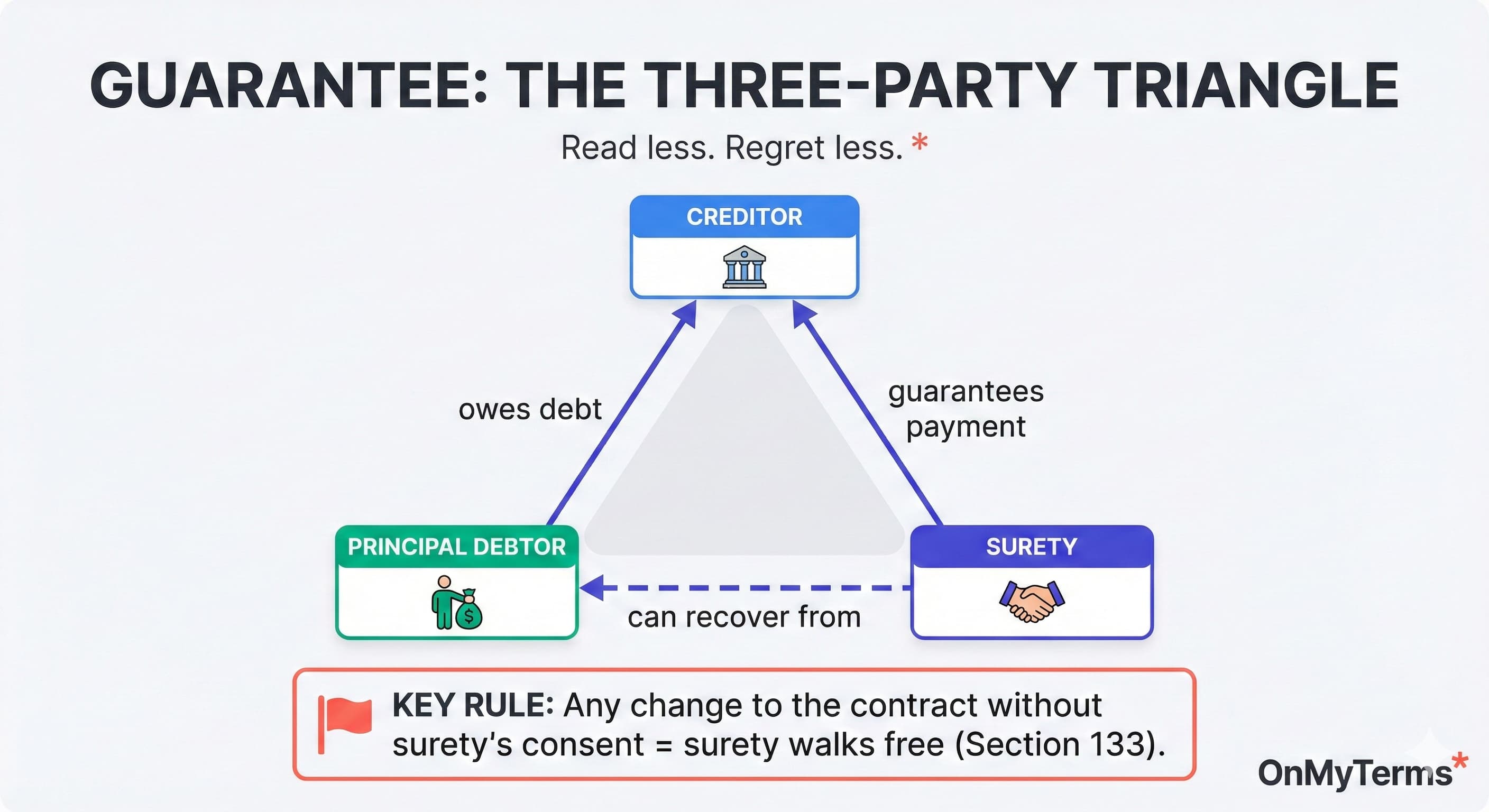
A guarantee involves three parties: the surety (who gives the guarantee), the principal debtor (whose default is being guaranteed against), and the creditor (to whom the guarantee is given).
Key principles:
- The surety's liability is co-extensive with the principal debtor's (Section 128) — unless the contract says otherwise.
- Continuing guarantees extend to a series of transactions and can be revoked for future transactions (Section 130). The surety's death automatically revokes a continuing guarantee for future transactions (Section 131).
- Any variance in the terms of the contract between the creditor and the principal debtor, made without the surety's consent, discharges the surety (Section 133). This is extremely important — even a small unauthorized change to the underlying deal can free the guarantor entirely.
- A guarantee obtained by misrepresentation or concealment is invalid (Sections 142–143).
Real-world impact: If you have co-signed a loan for a friend or family member, these sections define exactly when you are on the hook, and — critically — when changes to the loan terms without your knowledge release you from liability.
Bailment: When You Hand Over Your Stuff (Sections 148–171)
Bailment is the delivery of goods by one person to another for a specific purpose, with the understanding that the goods will be returned or dealt with according to the bailor's directions once the purpose is accomplished.
Every time you hand your car to a valet, give your laptop to a repair shop, leave luggage at a hotel cloakroom, or store goods in a warehouse — you are creating a bailment.
Key protections:
- The bailor must disclose known faults in the goods. If bailed for hire, they are liable for damage from faults even if they were unaware of them (Section 150).
- The bailee must take the care of a reasonably prudent person (Section 151).
- If the bailee uses goods inconsistently with the bailment conditions, the bailor can terminate (Section 153).
- The bailee is liable for any damage from unauthorized use (Section 154).
- If the bailee mixes goods without consent and they cannot be separated, the bailee must compensate for the loss (Section 157).
Pledge (Sections 172–179)
A pledge is a special type of bailment where goods are delivered as security for a debt or promise. The pawnee (person receiving the pledge) has the right to retain the goods until the debt is paid, and even to sell them after reasonable notice if the pawnor defaults (Section 176).
Agency: Who Can Act on Your Behalf (Sections 182–238)
The law of agency governs every situation where one person (the agent) acts on behalf of another (the principal). This chapter is becoming increasingly relevant in the digital age — think payment gateways, delivery platforms, and AI assistants conducting transactions.
Core Principles
- Any person can be an agent (Section 184), and no consideration is needed to create an agency (Section 185).
- An agent's authority can be express or implied (Section 186).
- In an emergency, an agent has the authority to do whatever a person of ordinary prudence would do to protect the principal's interests (Section 189).
Agent's Duties
- Must conduct business with the skill and diligence that is reasonable (Section 212).
- Must render proper accounts (Section 213).
- Must not deal on their own account without the principal's consent (Section 215).
- Not entitled to remuneration for business misconducted (Section 220).
Principal's Duties
- Must indemnify the agent against consequences of lawful acts (Section 222) and acts done in good faith (Section 223).
- Must compensate the agent for injury caused by the principal's neglect (Section 225).
Termination of Agency (Sections 201–210)
An agency terminates by: revocation by the principal, renunciation by the agent, completion of the business, death or insanity of either party, or the principal becoming insolvent.
But here's the catch — if the agent has an interest in the subject-matter of the agency, the agency cannot be terminated to the prejudice of that interest (Section 202).
The Sections Nobody Reads — But Everyone Should
Section 27: The Non-Compete That Probably Won't Hold Up
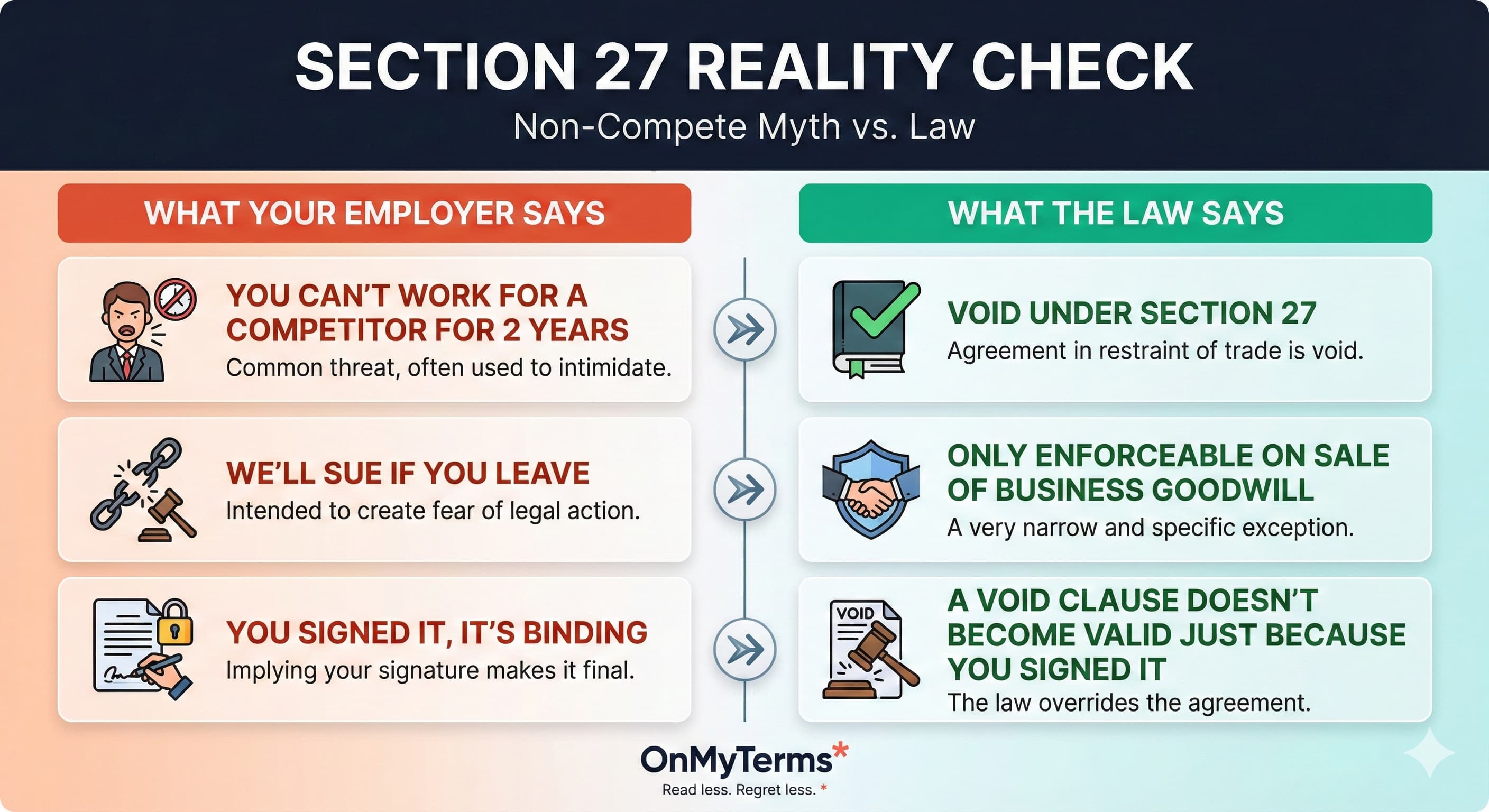
If your employment contract or freelance agreement contains a blanket non-compete clause, it is almost certainly void under Section 27. The only exception is an agreement not to compete tied to the sale of a business's goodwill, within reasonable limits. Employers routinely insert non-compete clauses anyway, counting on the fact that employees don't know the law. Now you do.
Section 28: The Arbitration Trap
Many contracts now include mandatory arbitration clauses and limit the time within which you can file a claim. While arbitration itself is preserved by the exceptions to Section 28, clauses that extinguish your rights after an artificially short period may be void.
Section 23: The Catch-All
The consideration or object of an agreement is unlawful if it is forbidden by law, would defeat any law, is fraudulent, involves injury to person or property, or is immoral or opposed to public policy. This section is the courts' safety net — and it has been used to strike down everything from agreements to suppress criminal prosecution to contracts with immoral purposes.
How This Affects Your Everyday Documents
Let's bring this back to reality. Here is how the Indian Contract Act touches the documents most people sign without thinking:
Rental agreements: Governed by offer/acceptance rules (Sections 3-9), must have free consent (Sections 13-19), cannot contain unreasonable restraints (Section 27), and can be voided if obtained through undue influence (Section 16) — say, a landlord pressuring a desperate tenant into unfair terms.
Employment contracts: Non-compete clauses are largely unenforceable (Section 27). Clawback provisions on bonuses are valid only if they meet the test of lawful consideration (Section 23). Termination clauses that strip you of legal rights may be void (Section 28).
Freelance and consulting agreements: NDAs with hidden non-competes that go beyond protecting confidential information may be void (Section 27). Unlimited indemnity clauses must still meet the standard of reasonableness under Section 73. Penalty provisions are capped at reasonable compensation under Section 74.
Loan guarantees: If you have co-signed someone's loan, any change the bank makes to the loan terms without your consent releases you from the guarantee (Section 133). Banks frequently restructure loans without notifying guarantors — which is exactly when you should invoke this section.
Online terms of service: Yes, clicking "I Agree" constitutes acceptance (Section 8). But if the terms contain provisions that are unconscionable, obtained through undue influence (think monopolistic platforms with no real alternative), or restrain legal proceedings beyond what the law allows, specific clauses may be unenforceable.
What On My Terms Does for You
Here is the honest truth: nobody is going to read 238 sections of a 150-year-old law before signing their next lease or employment contract. And you should not have to.
That is exactly why we built On My Terms.
Upload any legal document — a rental agreement, employment contract, NDA, freelance agreement, loan document — and our AI-powered analysis engine will:
- Generate a plain-English summary so you understand what you are actually agreeing to
- Flag red flags and risky clauses like hidden non-competes, unreasonable penalty provisions, one-sided indemnities, and auto-renewal traps
- Identify questions you should ask before signing
- Assign a risk score so you can quickly gauge how lopsided the document is
We built this tool because we believe understanding a contract should not require a law degree. The Indian Contract Act gives you powerful protections — but only if you know they exist. On My Terms bridges that gap.
Stop signing documents blindly. Upload your next contract to On My Terms before you sign.
Key Takeaways
- Every agreement is not a contract. Free consent, lawful consideration, competent parties, and a lawful object are all required.
- Consent must be truly free. Coercion, undue influence, fraud, misrepresentation, and certain mistakes can all undo a contract.
- Non-compete clauses in employment contracts are almost always void under Section 27. Don't let them scare you.
- Penalty clauses are capped at reasonable compensation under Section 74. A contract cannot impose disproportionate punishments.
- If you co-signed a loan guarantee, any unauthorized change to the loan terms releases you. Know your rights under Section 133.
- Vague agreements are void. If the terms are not clear or capable of being made certain, Section 29 says there is no contract.
- The doctrine of frustration exists. If a contract becomes impossible or unlawful after formation, it is void under Section 56.
- You do not need to memorize 238 sections. You just need the right tool to decode the contracts that affect your life.
The Indian Contract Act, 1872 has survived for over 150 years because its principles are timeless. But the documents built on top of it have only gotten more complex. Don't let complexity become an excuse for someone else to take advantage of you. Understand your contracts. Understand your rights. Do it on your terms.
Don't sign what you don't understand
Upload your document and get a plain English breakdown in minutes.
Analyze Your Document